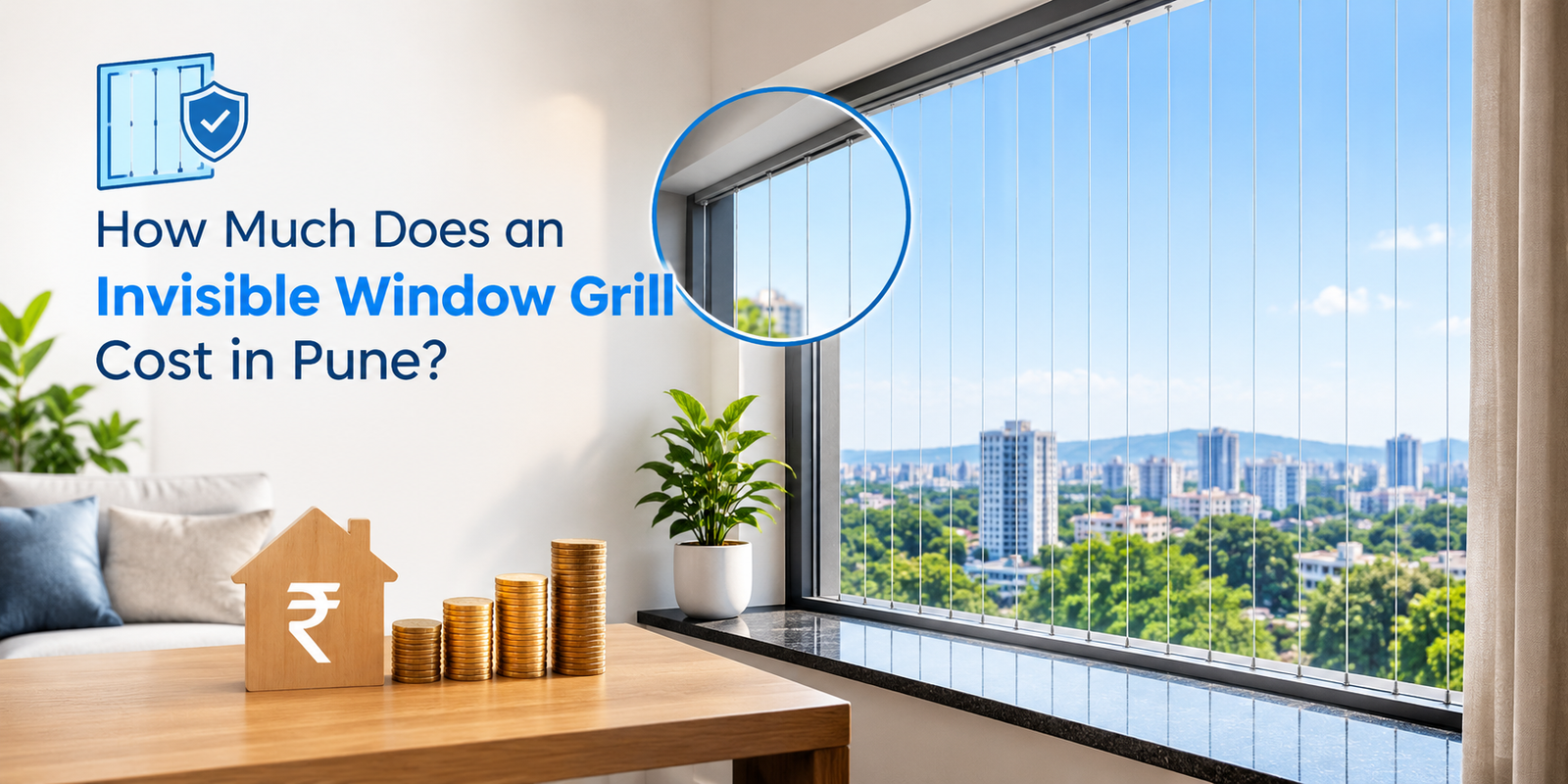
If you’ve started researching window grill cost options for your home, you’ve probably noticed there’s no single number floating around online — and that’s not sellers being vague on purpose. Invisible window grill price genuinely depends on a handful of factors specific to your home, and understanding them upfront means you won’t be caught off guard by the quote you receive on-site. This guide breaks down exactly what goes into that number, so you can evaluate any quote — ours or anyone else’s — with real context instead of guesswork.
Why There’s No Fixed Price Online
Any installer quoting a flat, one-size-fits-all price without seeing your windows is either estimating loosely or leaving room to adjust the number later, once they’ve actually assessed the site. A proper invisible grille price is calculated after a physical site visit, because the same “per window” rate can shift significantly depending on what’s actually being installed — the material, the window type, and the building itself all play a role.
This is also why two quotes for what looks like the “same” installation can differ by a noticeable margin. The difference usually isn’t arbitrary; it comes down to the specific factors below.
1. Number of Windows
Pricing is typically structured per window, which means a full flat with 6-8 windows generally costs less per unit than a single window installed on its own. This is fairly standard across the industry — fixed costs like the site visit, laser measurement, and setup time get spread across more windows, so the per-unit rate drops as the job size grows.
If you’re getting a window safety grill cost estimate for just one room or a single problem window, expect a higher per-window rate than what a whole-home installation would work out to. It’s worth keeping this in mind if you’re planning to do the rest of the flat later — bundling windows together upfront is usually more cost-effective than doing them one at a time over several months.
2. Window Size and Type
A large sliding window naturally needs more cable length and a longer aluminum track than a small casement window, so size directly affects material cost. Bay windows, unusually wide openings, or windows with irregular shapes will also cost more than a standard-sized rectangular window, simply because they require more precise measurement and often more cable strands to maintain proper safety spacing.
Sliding, casement, and fixed window types can also differ slightly in installation approach, which is another reason a size-and-type breakdown matters more than a flat “per window” number when you’re comparing quotes across different homes or even different rooms in the same home.
3. Frame Material
Wooden frames sometimes need different fasteners than concrete or aluminum frames, which can affect both the material used and, occasionally, the labour time required. Concrete and aluminum frames are usually the most straightforward to work with, while older wooden frames may need additional care to ensure the anchor points hold securely over time.
This is one of the details an installer genuinely needs to check in person during the site visit rather than estimate over a phone call — frame condition and material aren’t always obvious from a photo, and getting this wrong at the quoting stage leads to price surprises later.
4. Floor and Access
Upper floors without direct balcony access can add setup time for the installation team, since equipment and materials need to be carried up and the work itself may require additional safety precautions. Ground-floor installations, by comparison, are usually quicker to access and set up, which can modestly affect the overall time — and by extension, cost — of the job.
This factor tends to matter more for buildings without a working lift, or for older constructions where access to certain windows requires extra care.
5. Cable Grade
Not all invisible grill pune sellers quote the same grade of steel, and this is one of the most important — and most overlooked — factors in any price comparison. SS316 marine-grade cable costs more upfront than lower-grade or uncoated steel wire, but it’s also the grade built to hold up against Pune’s monsoon humidity and pollution exposure without rusting.
This means a lower quote using a weaker grade of wire isn’t really a fair like-for-like comparison against a quote using SS316 — you’re not comparing the same product at two different prices, you’re comparing two different products. A cheaper installation that needs cable replacement in 18-24 months due to corrosion ends up costing more over time than paying for the correct grade from the start.
What a Fair Quote Should Include
Before comparing prices between installers, make sure each quote clearly specifies the following:
- The exact steel grade — “stainless steel” alone isn’t specific enough; ask whether it’s SS304 or SS316, since the difference in corrosion resistance is significant
- Pricing structure — whether the price is per window, per running foot, or a flat package rate for the whole home
- Warranty terms in writing — a verbal promise of “rust-proof” or “long-lasting” means little without a signed warranty document specifying the term
- What’s included — whether the track, hardware, and fasteners are part of the quoted price or charged as separate line items
A quote missing any of these details is genuinely hard to compare fairly against another, even if the headline number looks lower. Two installers can quote very different prices for what appears to be the same job simply because one has left out material grade or warranty coverage from the conversation.
Modern Window Grill Design, No Extra Premium
One thing worth knowing before you start comparing: a transparent window grill or modern window grill design — the kind that doesn’t block your view or noticeably change how the building looks from outside — isn’t typically priced as a premium add-on over a standard window grill. It’s simply how invisible cable grills work by design.
A traditional welded or wrought-iron window grill involves separate cost considerations for paint finish, design pattern, and periodic repainting to prevent rust — costs that continue well after installation. An invisible cable grill, once properly installed with the right grade of steel, doesn’t carry those ongoing maintenance costs, which is worth factoring into any long-term cost comparison, not just the upfront number.
Get an Exact Number, Not an Estimate
Because so much depends on your specific windows — their size, type, frame material, and your building’s access — the only way to get a genuinely accurate number is a site visit. Estimating online, even with all the factors above in mind, will only get you in the right range, not an exact figure.
We offer a free, zero-obligation site inspection across Pune, including laser measurement of each window opening and a written quote provided on the spot — so you know the exact cost before committing to anything. If you’ve been searching for an invisible grill near me in Pune, our team covers all major localities across Pune and PCMC, and you can get in touch here to schedule your visit.
For full technical specifications on cable grade, track material, and what’s included in every window installation, see our Invisible Grill for Windows page